Wed
27
Feb '08

Okay, so Kawasaki me too!

As I was perusing my Twitter stream to see what I missed today (while actually conducting a 20 hour workday, if we count the fact that I had to get up at 4am to fly from Hamburg to Vienna, do press interviews immediately upon arriving at the venue and then, after six straight hours of presentations, head for the airport to fly to Dublin in order to speak at the first ever Irish Web Technologies Conference tomorrow… er, today, since it’s now past midnight), I noticed a Twitter from Guy Kawasaki referring back to a blog post – see the post from Köln and Hamburg for more info on Guy. Just had to blog this, since it is one of the funniest posts I’ve read in a long time.

What I forgot to mention in that post is the fact that I had the pleasure of presenting GoLive Cyberstudio (I’m mentioned in the article – and yes, back to the original conversation, as the GoLive evangelist) in one of Guy’s infamous “post-MacWorld-keynote” keynotes. For those that don’t remember these stalwarts at MacWorld, or were perhaps not even born… these events were legendary. Guy would invite what he saw as the coolest technologies for the Mac from the previous year. Then, you got 5 minutes – and ONLY 5 minutes – to impress not only Guy, but the audience in general, with your absolute best demo ever. I’m proud to say, as I walked off stage after my 5 minutes of fame, Guy said to the audience “That was amazing! That guy should sell juicers on late-night television!” Or, as my boys would say, “w00t!”

And on a complete sidenote, that year was the first year that Steve Jobs (who I also have gotten to meet several times) graced the MacWorld stage after leaving Apple. Little did Gil Amelio (remember him?) know what was about to happen…

Anyway, it is great fun to get to meet famous people – and even more fun when they actually know what you do, or at least the technology that you are a part of helping to create. Like the immigration officer in Australia that asked “who do you work for?” And when I responded (at the time) “Macromedia”, he said “I love Flash – it’s so cool!” Now, that immigration officer isn’t famous, but the fact that technology can reach across borders, boundaries, income levels, etc is defintely amazing. The difference is how the “famous” treat you, or if you’re so lucky to be “the famous one”, how you treat others. Because I’ve been around this industry soooo long, and have had the pleasure to be associated with some of the most famous and successful pieces of software to be released within the web space, I often get the “famous” treatment – not to the level of Steve Jobs or Guy, but it’s still fun nonetheless. However, my friends, I still love hearing from you, talking with you after my presentations and, most importantly, even learning from you! You’re the real heroes out there – the ones creating amazing content with Adobe tools. I can’t begin to tell you how much I’ve “borrowed” from your ideas and questions to help shape my demonstrations and presentations.

Now, ask me nicely and I might tell you the story of how not only did I get to meet Paul McCartney – but I got to spend five, uninterrupted hours talking with him… Cheers!
Wed
27
Feb '08

By Popular Demand: Seminar Recording

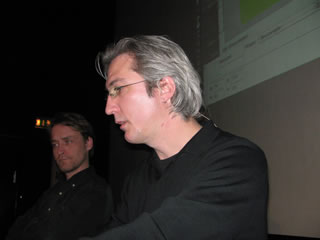
Everyone has been asking on this tour if there is a recording that they can see… Well, there’s good news and bad news… The exact 6 hour seminar that we’ve just done in Germany/Austria was not recorded. However, there is a recording of a very similar session that Jason, Stephanie Sullivan and I did in Stockholm recently. For those that are interested, the recording is here. Enjoy!

Update: I was just informed that one of the attendees has been filming our session today in Vienna and will be passing the URL to us. As soon as I have it, I will post it here to the blog.

Wed
27
Feb '08

Adobe Masters Tour – Köln and Hamburg

Waiting On My Turn…Well, the German leg of the Adobe Masters Tour has come to a close. Jason, Rufus and I have had a blast. Yesterday over 250 Adobe fans braved the rain in Hamburg – while on Thursday, our Kölsch friends came out in strength, with 480 turning up to spend the afternoon with us.

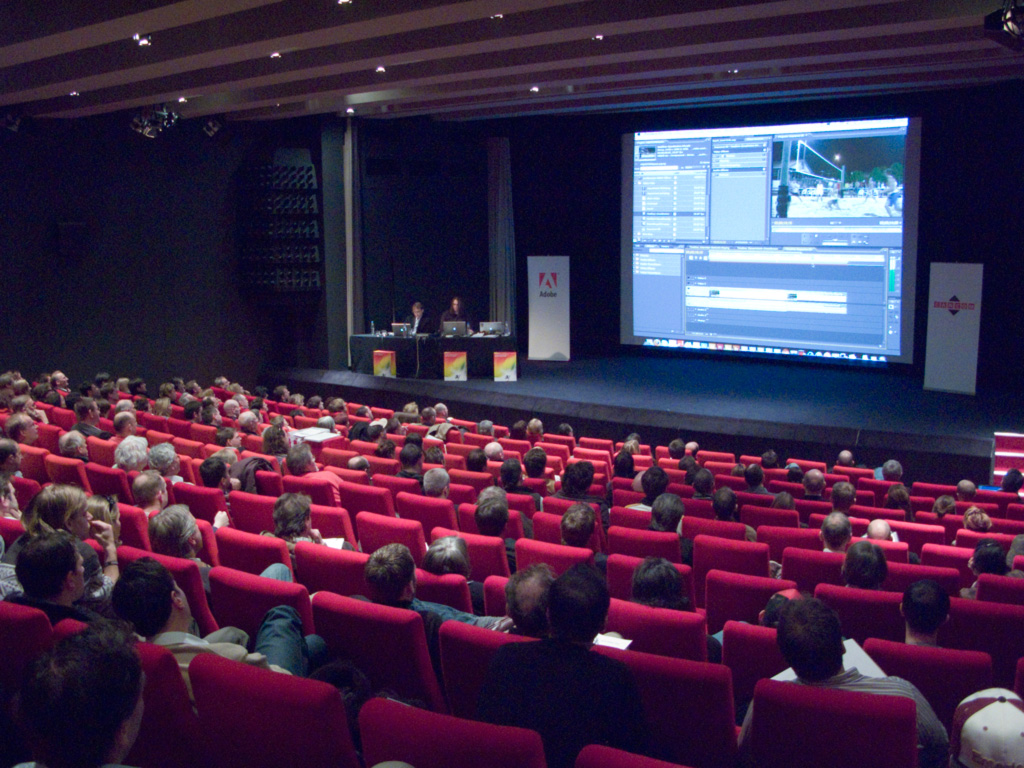
The Köln Venue was PACKED!!Unfortunately, the gremlins really got a hold on us in Hamburg. Up to now (and really on every tour) the problems that we’ve encountered in venues have been really minor. But in Hamburg, during the set-up, of all things, the router in the theater decided to die. And, needless to say, it’s hard to show web sites when you don’t have a web connection. The AV and IT team at the theater really knocked themselves trying to track down the problem – and eventually they ended up running over to the local computer store to grab a new dsl router. Sadly, it took so long to solve the problem that our Hamburg friends did not get to see Rufus’ demonstration of Kuler or the Google 3D Warehouse plugin for Photoshop.

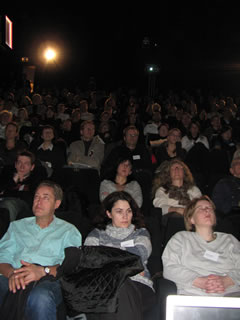
The Crowd in HamburgOh, we also received an “interesting” email from an attendee who was somewhat “insulted” that we use the title “evangelist”. He seems to feel that that title is reserved for church use only. Well, as you all hopefully know, we don’t mean to offend anyone with our job titles. However, the title of evangelist has been in use in the computer/software industry since Guy Kawasaki coined the use of the title while at Apple back in the 1980′s (remember those days, anyone?). Shortly after that time, every major computer maker and software company had to have an “evangelist”. And Webster’s defines an evangelist (in addition to the religious connotation) as a “zealous advocate of something”. Well, my friends, if there is one thing that everyone on my team is, then that’s “a zealous advocate” of Adobe technologies – in other words, we are truly evangelists! Prost!

Mon
25
Feb '08

Adobe AIR takes to the, um, air!

Okay, pardon the pun in the title, but Adobe AIR is finally out of beta and has been officially born. And not just AIR, Adobe Flex 3 is also a real product now. You can read all about AIR here and about Flex 3 as well. But in a nutshell for those that want the “down-n-dirty” version, AIR is Adobe’s new development platform. Together with Flex 3, our open source development framework, they allow developers to develop RIA’s (now, Rich, Interactive Applications) that both work within the context of a browser (like the old RIA term), and on the desktop as a standard “desktop” application. You can, of course, also use other technologies such as HTML/Ajax (using Dreamweaver CS3), as well as Flash to build AIR applications.

What makes AIR special are two key points, first, AIR applications are “internet” aware. In other words, they can connect to the web and retrieve information – but still hang onto and manipulate the information after the web connection is no longer present. Imagine being able to begin a shopping transaction, but then put your laptop to sleep, wake it up on the subway (with no internet connection), restart the shopping application – have it know exactly where you were in the process, then allow you to continue all the way to the final “submission” step, without the internet connection. Finally, when you arrive at home or the office, restart the application and have it process the transaction. Too cool! And then, the second main point, AIR applications can be built completely cross-platform. Remember the “build once, deploy everywhere” mantra of Java from a few years ago? Well, with AIR, this dream has now become a reality.

To my fellow colleagues who’ve worked long and hard to bring Flex 3 and AIR to life, well done! Cheers!!!

Wed
20
Feb '08

Adobe Master’s Tour – Munich and Frankfurt

The Adobe Master’s tour through Germany is off and running. Yesterday we had a great crowd in Munich, where about 360 of our closest friends joined us for an incredible 6 hours of fun with Adobe Creative Suite Master Collection, and today about 300 showed up in Frankfurt. Believe me, six hours is a really long time to sit and watch a demonstration, but it seems that everyone enjoyed themselves as they all stayed to the very end.

Unfortunately, even with six hours, there was still a lot that we wanted to cover – but we simply couldn’t fit it all in. And sadly, one of my favorite new features that I couldn’t get to was Spry. (Don’t worry, Spry fans – I’ll be trying to juggle some of the other features in order to get it in in future stops on the tour.) But for my friends in Munich and Frankfurt, I want to fill you in on Spry.

First of all, what is Spry? Well, Spry is an Ajax framework – or in other words, it’s a collection of JavaScripts which we’ve created for you to use to implement Ajax functionality in your web sites. While it is built directly into Dreamweaver CS3, you can use Spry with any HTML authoring tool – yes, even Notepad! But if you are a Dreamweaver CS3 user, before you dive into Spry, make sure to run up to Adobe Labs and download the latest version of Spry – version 1.6. This new version of Spry includes an updater for Dreamweaver CS3, which shipped with version 1.4, to bring it up to date with Spry.

There are several really cool new features in Spry 1.6. First of all, there are a couple of new Spry widgets (or interface elements) like a sliding panel widget which allows the visitor to visually scroll through a lot of information in a limited space. But for me, the best new feature is the ability for Spry 1.6 to overcome one of the shortcomings of Ajax – what happens if JavaScript is disabled?

Up to now, Spry used XML in order to retrieve data – but if no JavaScript is present, no data would display. Now, with Spry 1.6, we have the possibility to read HTML as a data source. What this means is that we can designate an area of the page as “the data”. When Spry reads the data, it automatically hides that designated “data element” and displays the page with the Spry enhancements. When JavaScript is disabled, the browser displays the data element – and with a simple rule or two in CSS, we can hide the empty “enhancements”.

Finally, Spry 1.6 also supports the ability to externalize all of the Spry code – including all of the JavaScript calls – meaning that the entire JavaScript is unobtrusive.

If you want to learn more, check out the sample files and documentation that comes with the Spry 1.6 download – or buy “Mastering CSS with Dreamweaver CS3” (the book I wrote with Stephanie Sullivan), which will be on shelves in a few short weeks (finally). Chapter 6 covers Spry, HTML DataSets, along with the Sliding Panel widget in-depth.

And now, on to Cologne and a nice cold Kölsch… Prost!